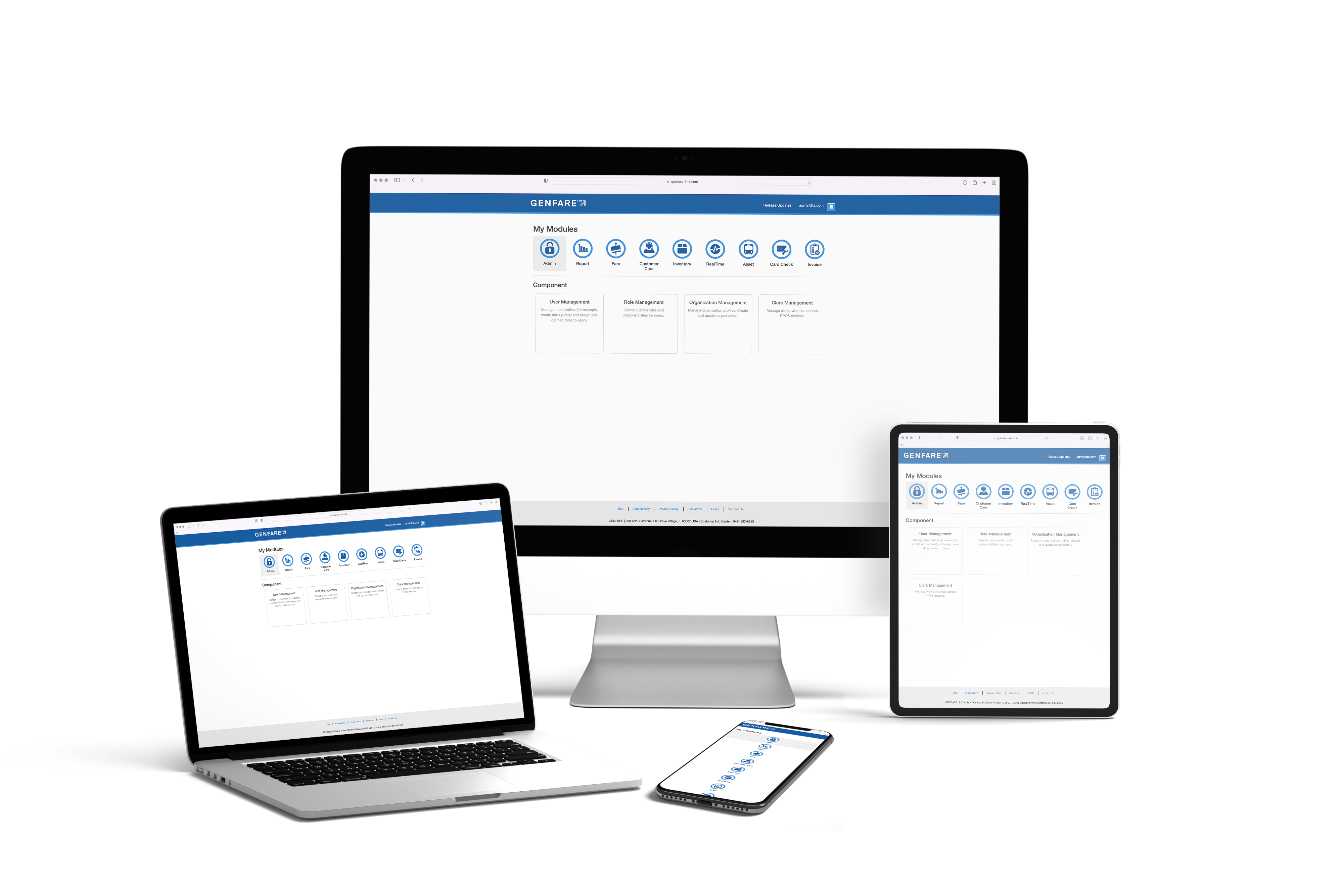
Cloud migration
Genfare is continuing to evolve our cloud-based Genfare Link platform as part of our ongoing commitment to provide reliable, modern, and future-ready fare collection systems that meet the growing needs of transit agencies and their riders. By moving to the cloud, Genfare Link will deliver improved scalability, performance, and long-term sustainability for your operations.
Benefits
- Stronger data security
- All data in one place
- Reduced IT burden
- Continuous updates
Benefits
What are the benefits of moving to the cloud?
Stronger data security: Cloud hosting protects your data with advanced encryption, regular backups, and instant recovery—eliminating reliance on aging on-premise systems.
All data in one place: Transaction, ridership, and device monitoring data from fareboxes, mobile apps, e-Fare portals, and retail channels are consolidated in one secure, centralized location.
Reduced IT burden: With no on-site servers to maintain, your agency’s IT resources can focus on higher-value priorities.
Continuous updates: The cloud allows Genfare to deliver ongoing enhancements, security patches, and feature updates automatically—without hardware refresh cycles or system downtime.
What are the key feature improvements?
Improvements of a cloud-based platform vs. the Garage Data System and Network Manager based platform include:
- Web-based configuration of all devices
- Consolidated reporting
- Automatic quarterly platform updates
- Modern dashboards
- Preventative and corrective maintenance alerts
- Easier integration of third-party data
Changes
When will this change take place?
Migration to the direct-to-cloud Genfare Link will be rolled out gradually with an estimated completion date of December 31, 2028. Genfare will work with customers to schedule transitions at a rate of two customers per month during 2026, 2027, or 2028. We’ll coordinate with you to find the best timing, using a transparent tracking system to manage resources and minimize disruption. Early engagement ensures you secure your preferred slot.
Transit agencies with third and fourth generation ticket vending machines will be prioritized for migration in late 2026 or early 2027 to accommodate the retiring of Vendstar Information Processor software.
What happens to Garage Data System (GDS) and Network Manager (NM)?
GDS and NM (and their associated databases and on-premise hardware) are being retired and replaced by direct-to-cloud communication via the cloud link application and the Genfare Link platform.
Consolidating fare management into the Genfare Link cloud platform will simplify deployments, improve usability, and strengthen security while supporting agencies of all sizes with one modern solution. Other improvements include web-based configuration of all devices, consolidated reporting, automatic quarterly platform updates, modern dashboards, preventative and corrective maintenance alerts, and easier integration of third-party data.
Fleet devices will send data through the cloud link application directly to Genfare Link, eliminating complex onsite networking and giving operations, finance, and IT one web-based system for configuration, reporting, and monitoring.
What will change in my system when Genfare Link moves to the cloud?
Current Genfare Link customers
If you have Genfare Link 1.0, your hardware devices are currently configured to transfer data through the GDS and NM to your Genfare Link software instance. The application and databases will be retired and hardware will be removed.
Once updated, your fleet devices will transmit data through our cloud link application directly to Genfare Link, eliminating the need for complex onsite equipment and ensuring a more streamlined and secure system architecture.
If you have Genfare Link 2.0, which is already on the cloud, nothing will change.
All other customers
Your hardware is currently configured to transfer data through on-premise hardware called the GDS and NM. GDS hardware will be repurposed for the new software. The current GDS software will be retired and removed from the operational workflow.
Once updated, your fleet devices will transmit data through our cloud link application directly to Genfare Link, eliminating the need for complex onsite equipment and ensuring a more streamlined and secure system architecture.
Impacts
What impacts will this change have to our agency?
There will be no downtime during the upgrade.
Once updated, your fleet devices will transmit data through our cloud link application directly to Genfare Link, eliminating the need for complex onsite equipment and ensuring a more streamlined and secure system architecture.
Onboard fare collection workflows remain largely the same: Riders pay as they do today and operators interact with the farebox in familiar ways. The major differences are in how data is transmitted and how quickly back-office staff can see status, revenue, and fault information, which should improve service quality without adding steps for drivers or riders.
Your agency will have a single source of truth, giving operations, finance, and IT one web-based system for configuration, reporting, and monitoring.
What are the implications of opting out?
Agencies that choose not to transition by the published dates will continue operating on legacy, end-of-life systems that are no longer actively supported. These environments will not receive ongoing software updates, security enhancements, new features, or future integrations. As industry standards evolve, maintaining compliance and system reliability may become increasingly challenging, and Genfare’s ability to provide full troubleshooting and long-term maintenance support will be limited.
What does this mean for our fare collection hardware?
GDS and Network Manager servers, associated databases, and their dedicated workstations are decommissioned and removed from your workflow as part of the project.
Fareboxes, vaults, and garage equipment remain in service, but they connect through the cloud link instead of probing into a GDS/NM server. Networking equipment (Wi-Fi or cellular infrastructure), and any required local connectivity components remain at your facilities. The “brains” for configuration, reporting, and monitoring move to Genfare Link in the cloud, reducing the amount of server infrastructure you operate locally.
The cloud-based system reduces reliance on legacy hardware, but some equipment may need updates. We’ll assess your setup and provide guidance to ensure compatibility and maximize your investment.
All current fareboxes, including most mixed-fleet configurations, are supported. Legacy fareboxes are also supported with the exception of some first and second generation CentsaBill fareboxes.
How will this affect security?
Genfare Link leverages AWS security, encryption, and availability along with automatic security patches and controlled access to significantly improve security over legacy GDS/NM deployments. Fewer on-premise servers, fewer open ports, and standardized software versions all reduce the overall attack surface.
Moving to Genfare Link in the cloud ensures your environment is always on the latest approved software version, including security patches and defect fixes, which reduces variance across sites and simplifies demonstrating compliance to auditors and regulators. Hosting on Amazon Web Services provides enterprise-grade security controls, logging, and availability that support industry and agency policy requirements more consistently than aging, distributed on-premise servers.
Genfare, in partnership with AWS, manages all server-side operating systems, including hardening, patching, and end-of-life transitions, so your IT team no longer has to maintain Windows/SQL servers for fare collection. This reduces OS drift between environments and lowers the risk of missed security updates on local machines.
Cloud-based identity and access management (IAM) centralizes user and role management, so access is controlled by named accounts and roles instead of shared local logins or workstation permissions. This supports least-privilege access, easier offboarding, and stronger authentication policies, and it lays the groundwork for single sign-on (SSO) with your identity provider.
How are updates and patches handled?
Updates to Genfare Link and the cloud link components are deployed centrally on a scheduled basis, rather than through manual, agency-by-agency upgrades. Farebox and device software can be updated over the air through Wi-Fi or cellular, shrinking upgrade windows from days or weeks to hours and reducing after-hours maintenance.
Costs
What are the cost implications of this change?
Genfare Link’s new pricing is comprehensive, simplified, and scalable. There are no surprise charges or fees – everything is included, from implementation to upgrades to support. And while the capabilities and performance of Genfare Link have grown significantly, the overall cost compared to the legacy solution has not, resulting in outstanding value for forward-thinking transit agencies.
For many agencies, year one costs are positioned at or below legacy GDS/NM pricing, with lower total cost of ownership over time from hardware, licensing, and labor savings.
Genfare Link’s pricing is based on a simple formula scaled to the size of your transit agency: a one-time implementation fee, plus an annual software subscription bundled with an annual support agreement, for the term of the contract. This combination encompasses everything and keeps the cost within reach of even the smallest cash, coin, and magnetic agencies.
Each customer will execute a Genfare Link Subscription and Service (SaaS) Agreement; existing SSAs are either appended or replaced so all hosted functionality and support are covered in a single agreement.
What’s included with the implementation and subscription fees?
Implementation: The implementation fee covers the migration of your data and systems to a robust cloud environment, access to advanced reporting tools, and comprehensive training—ensuring you receive maximum value and a seamless transition.
Subscription and support: Instead of large, infrequent hardware/software purchases, agencies pay recurring subscription and support fees that cover hosting, updates, and support, aligning costs with ongoing value and reducing upfront capital spend. This includes:
- Hosting on AWS
- Access to the Customer Portal for training, support, case management, and media ordering
- Reporting dashboards with filtering, sorting, exporting, and graphical data representation
- Quarterly software updates
- Device management