
 The public transit world thrives on teamwork, and this spring I was fortunate to lead a Genfare collaboration with an amazing group of engineering students from the University of Illinois Urbana-Champaign. With prompts from our team, the Spring 2026 senior engineering project cohort designed and built a real-world solution that has already sped up our smart card payment validation QA testing, helping us ensure that each of our Fast Fare® farebox card validators remains functional and reliable for years to come.
Solving a QA bottleneck
Genfare smart card validators are workhorses, performing thousands of rider transactions a day. Until now, we’ve relied on manual QA testing to simulate this in-house, with hours spent tapping fare cards on new fareboxes by hand. But as our client base grew alongside new product innovations, this manual QA became impractical. We were also concerned that issues that might occur in the field were hard to reproduce in the lab. We didn’t want to leave device durability, performance, and response times unvalidated.
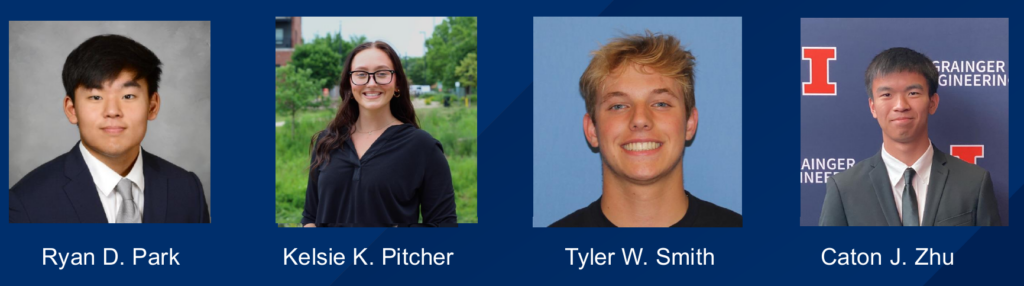
That’s where Genfare’s mentoring of UIUC’s engineering students has been incredibly rewarding — their innovation brings creative solutions to real-world challenges. This time, given parameters, some guidance, and three months of work, students Ryan D. Park, Kelsie K. Pitcher, Tyler W. Smith, and Caton J. Zhu built a fully automated, conveyor-belt fixture that mechanically taps cards at the farebox — with no manual tapping required. We can set up the rig in minutes, freeing up time that our engineers can use to create and troubleshoot solutions for our agency partners.
The prototype is now housed in Genfare’s QA lab and is being used to simulate high-volume rider transactions, validate backend reports, and test new payment processors under tight project deadlines.
Hundreds of QA hours saved
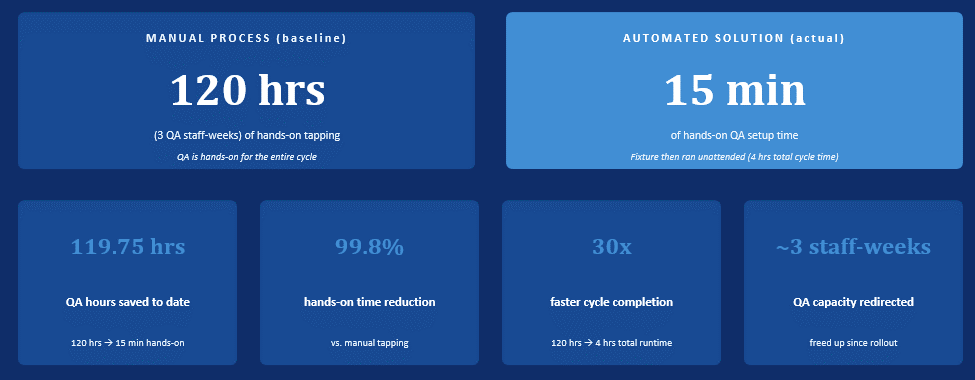
In the first three months of use, we estimate that this new QA testing solution saved us almost 119.75 hours — about a 99.8 percent reduction in hands-on work, or approximately 3 weeks of QA that our engineers could redirect into higher-value work like exploratory testing and defect analysis. If we continue at that rate of usage throughout 2026, I think we will be able to save about 480 hours of manual QA.
By stress-testing system hardware and software before installation, Genfare catches potential bugs and failures early, delivering a stable, dependable product to our transit agency partners.
Impactful goals
Scalability and automation are not just technical goals — they require strong process design and usability considerations. This is the first student project we’ve done that has combined both mechanical engineering — with the physical conveyor belt hardware — and software automation. The students created something practical, easy to operate, and that we could integrate into our Genfare QA team’s existing workflow.
The University of Illinois faculty and the wonderful student team helped make this partnership an extremely valuable experience. The students approached this challenge with curiosity, dedication, and fresh perspectives, making the project both impactful and enjoyable. We’re looking forward to seeing these bright engineers achieve great things in the future!