
In part 1 of this series, I explained that key to successfully advancing interoperability is to make sure standards are implementable, repeatable, and scalable. I shared four actions for advancing interoperability at a national level and five next steps to help our industry make progress toward these goals. In this post, I’ll discuss what Genfare is doing to advance transit data interoperability.
How Genfare is operationalizing data interoperability
 Fare systems were originally designed as closed, device-centric solutions. A lot has changed over the years. Today, agencies are asking for open, cloud-based platforms that integrate across their enterprise. To meet this need, Genfare has evolved from device-centric fare collection to a connected, data-enabled platform, with interoperability as a foundational requirement.
At Genfare, we take a practical approach to interoperability, delivered where it matters most. We are operationally driven – we believe that data isn’t truly interoperable if it can’t be acted on, whether it’s by finance, operations, customer service, or planning.
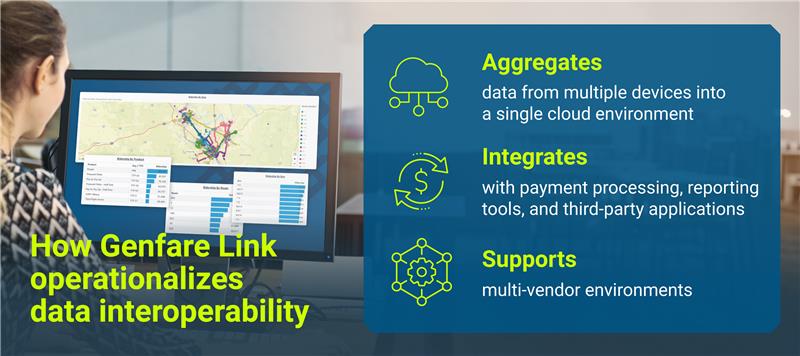
At the core of this ecosystem is Genfare Link, our cloud-based back-office solution designed with APIs. Genfare Link:
- Aggregates data from multiple devices into a single cloud environment
- Integrates with payment processing, reporting tools, and third-party applications
- Supports multi-vendor environments
Here’s how it delivers:
Data sharing and interpretation
Genfare Link not only aggregates all fare transactions and events from all sources into a single source of truth, it exposes them via tools and interfaces agencies can use for planning, operations, and reporting.
Interoperable fare media and open payment
Open payment is growing fast in transit, and for good reason. One of its many benefits is that it aligns transit fare systems with widely used financial standards, improving cross‑system usability. However, since open payment is not available to unbanked and underbanked people, Genfare will continue to also accept existing media (e.g., smartcards, mobile tickets, cash).
Data for planning and equitable mobility
Genfare Link is the main contributor to the first pillar of equitable mobility: Know your community. Complete data from the entire system helps agencies make data driven decisions, further lowering barriers to interoperability.
Interoperability priorities
There’s a difference between enabling data access and operationalizing it at scale. Interoperability only delivers value when it’s reliable, secure, and proven in production. True interoperability goes beyond moving data to enabling better decisions, better service, and better outcomes for riders.
That only happens when systems are designed to work together from the start, which is why it’s important to look at the big picture. When it comes down to it, many of the improvements we make in transit are about reducing friction, and data interoperability is no exception.
The biggest opportunities for improvement in transit data interoperability are around how agencies share trip information, fares/payments, real-time operations, and performance/equity metrics across modes, vendors, and jurisdictions.
For example, newer capabilities like fare capping would be even more valuable if they worked across both systems and fare media. Imagine if the same benefits to riders could be made available across all types of fare media – even open payment.
Priorities for interoperability include:
- Fare, payment, and revenue data: Fare collection generates rich datasets, yet they are often isolated. Fare payment data standards are late to the game and often take fragmented and proprietary approaches. If better aligned, we could support interoperability models across systems and media.
- Real-time operations and asset health: We are increasingly collecting fare system health data, but it remains underutilized. When used well, we can shift from reactive service calls to predictive maintenance.
- Customer experience data: Riders don’t experience transit in silos, but data often lives that way. Getting a more complete picture will help with more consistent messaging, faster issue resolution, and better program design.
- Cross-agency and regional data sharing: Regional travel doesn’t stop at agency boundaries, and data sharing shouldn’t either. Better sharing can make true door-to-door, multimodal trip planning more seamless.
- Real-time schedule information: Agencies still produce GTFS schedule feeds of varying quality, creating inconsistent rider information. Generating and standardizing interoperable, high-quality GTFS real-time feeds will also go a long way toward higher rider satisfaction.
- Equity data: Data surrounding equity, such as access for people with disabilities, low-income riders, or unbanked riders, lacks common data structures and metrics, making it difficult to compare outcomes across regions or integrate into planning tools.
- Governance, contracts, and data sharing: Even where technical standards exist, inconsistent data‑sharing policies, restrictive contracts, and unclear governance often block interoperable use of data among agencies, private providers, and app developers. We need clearer guidance, template agreements, and funding incentives to normalize open, non‑discriminatory data access across the mobility ecosystem.
How MaaS Alliance has shaped the vision
Organizations like MaaS Alliance have a history of advance the vision for seamless, multimodal mobility and alignment across stakeholders. They provide a crucial focus on policy, frameworks, and best practices for integrated mobility. At Genfare, we support the goals MaaS Alliance promotes, such as seamless journeys, integrated payments, and multimodal access.
Overall, MaaS plays an important role in improving how riders plan and pay for trips across modes. However, it succeeds only when the core transit systems underneath it are reliable, interoperable, and financially sound. That’s where Genfare and other vendors come into the conversation. Our focus is on ensuring every transaction behind the rider experience is accurate, secure, and auditable. This puts our emphasis on:
- Transaction integrity
- Fare policy enforcement
- Revenue settlement
- Security, compliance, and uptime
- Long-term operational support
Even though Genfare is not a MaaS app provider, we provide the foundation needed to make MaaS work. We ensure public transit – the backbone of many journeys — can scale and integrate cleanly into MaaS ecosystems.
Learn more
Read more about Genfare’s approach to interoperability and the Internet of Things. Or, watch this video about the benefits of Genfare Link.