
At Genfare, we believe interoperability is essential. Done well, interoperability has the promise of great benefits. But there’s an issue holding transit agencies back from realizing these benefits: Interoperability isn’t about checking a standards box. It’s about whether agencies can actually use that data to improve service, reduce downtime, and serve riders better.
 Genfare was recently invited to participate in a data interoperability panel by the Intelligent Transportation Systems Joint Program Office, a program of the U.S. Department of Transportation. At this panel, I presented a case study demonstrating Genfare’s approach to data interoperability and explored answers to questions alongside other transit professionals.
Preparing for this event gave me an opportunity to collect my thoughts on the intersection of interoperability and data, which went much deeper than I had time to express on the panel. This is the first of two posts on the topic.
The next phase of interoperability
We’re grateful to organizations like Cal-ITP for the role they have played in advancing the discussion on interoperability. They’ve accelerated standards adoption and helped agencies modernize faster. But as we enter the next phase, long-term success depends on pairing that momentum with proven platforms, operational discipline, and partners who will be there for the full lifecycle.
Initiatives like Cal-ITP help define the ‘what’ and the ‘why.’ It’s vendors like Genfare who are responsible for delivering the ‘how’ — securely, reliably, and at scale. Moving from policy alignment to operational reality is where interoperability gets complex; and that’s where experienced system providers play a critical role.
At Genfare, we align with Cal-ITP’s goals around open standards, interoperability, and vendor-agnostic outcomes. And we’re ready to translate policy and standards into reliable, production-ready systems to deliver results.
4 actions for advancing interoperability at a national level
The key to successfully advancing interoperability is to make sure standards are implementable, repeatable, and scalable. We need to move away from one-off integrations to sustained, pragmatic solutions. This requires four actions:
Stronger, practical standards adoption
As we continue to advance national standards, we need to make sure they go beyond theoretical to implementable. They must be aligned with real procurement, security, and operational restraints. To accomplish this, we should encourage convergence across standards to prevent fragmentation.
Procurement that rewards interoperability
At Genfare, the exciting RFPs explicitly require open interfaces, documented APIs, and data portability. They evaluate vendors not just on compliance, but on proven interoperability in production. They insist on retaining ownership and access to their data, regardless of vendor. When this becomes the norm, everyone benefits.
Federal funding alignment
Advancing transit data interoperability nationally requires tying federal money and oversight on transitioning to subscription data models, clear data-sharing rules, and practical support for agencies and vendors. Federal programs can accelerate interoperability by incentivizing cloud-based modernization and supporting integration work – not just new hardware deployment.
Interoperability should be viewed as critical infrastructure, not an optional feature.
Public-private collaboration
In a perfect world, agencies, providers, and standards bodies would sit down together to discuss current technological gains and future wants. This collaboration can sharpen the focus on real-world implementation lessons and the challenges of security, privacy, and governance issues on data sharing. Public-private initiatives can move us a long way toward the goal of repeatable interoperability patterns.
5 steps toward interoperability
Out of these four actions comes a list of must-have next steps that will help our industry make progress toward these goals.
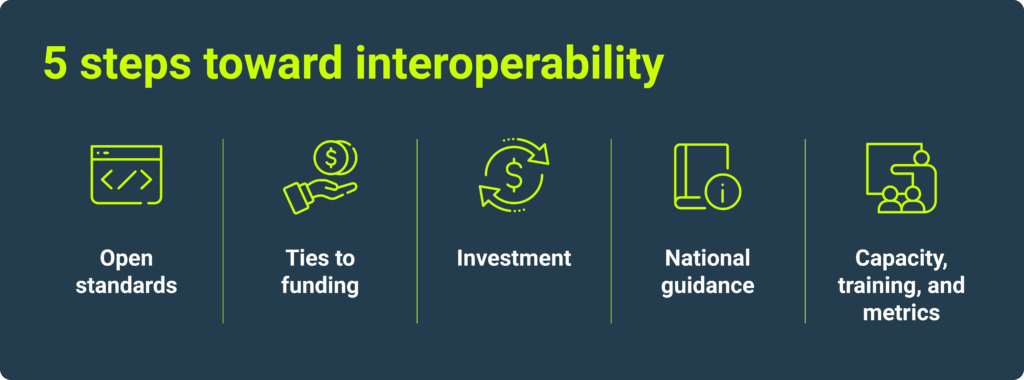
Make open standards the default
We must prioritize support for “interoperability first” efforts like the Mobility Data Interoperability Principles (MDIP) and the work the MaaS Alliance is doing. At the same time, we should be emphasizing implementation and conformance profiles instead of inventing new formats.
This means putting pressure on FTA and USDOT programs to treat key open standards as the expected baseline. GTFS and its variations, GBFS, open-loop EMV, and other standards should be required with waivers only issued for narrow cases.
Tie funding to open data and APIs
We would like to see open, documented APIs and shareable mobility data a condition or scoring factor for key competitive grants. These would ideally include reasonable timeframes and technical assistance. The DOT could further encourage use of common data-sharing terms by providing model grant language and contract templates that prevent vendors from locking up core transit data.
Invest in standards development and tooling
FTA’s Standards Development Program could be expanded to fund multi-year work on mobility data standards, testing tools, and conformance certification. Ideally, this would be coordinated with APTA, MobilityData, and MDIP. The program could support open-source tools, validators, and reference implementations. This would enable even small and rural transit agencies to publish high-quality interoperable feeds without bespoke development.
Create national guidance on governance and contracts
Published federal guidance on data governance would clarify ownership, privacy, and acceptable use. It could establish minimum access rights for public agencies and their partners, drawing on the Mobility Data Standards and Specifications for Interoperability report. Included in this guidance could also be standard contract clauses, the prohibition of proprietary “walled gardens,” and due-diligence checklists.
Build capacity, training, and equity-focused metrics
We need more funding for national training, peer exchanges, and a technical assistance center. This would provide the resources transit agencies need to operationalize interoperability principles – not just comply on paper. Incorporating performance and equity metrics into federal reporting guidance and research agendas can also go a long way toward ensuring access, reliability, and affordability goals are met across modes.
Coming up next
In my next post, I share what Genfare is doing to advance transit data interoperability and which transit data areas and processes can be improved through interoperability as well as share Genfare’s point of view on MaaS.