
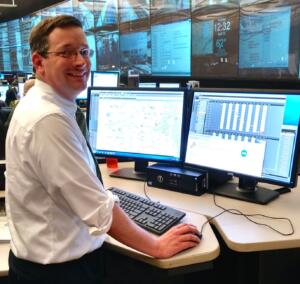
Genfare Program Manager Mike Haynes brings deep knowledge of transit data analysis and integration to comprehensive farebox installations and SaaS backend upgrades. Read the employee spotlight to learn about Mike’s deep roots in transit, his thoughts on a tough question facing the industry, and who the real White Sox season ticket holder is in his family.
You’ve got more than 23 years of experience in transit! How did it all begin?
I have a bachelor’s degree in civil engineering from Lafayette College in Easton, Pennsylvania, with classes in transportation engineering and in mass transit systems. My undergraduate interest in transportation laid the foundation, where I then went on to get a master’s degree in transportation engineering from the University of Texas at Austin. I will admit that riding buses for an Intro to Mass Transit class as an undergraduate, and daily to campus on CapMetro, was a foreshadowing of what was to come.
What do you love about the public transit industry?
That bus coming down the street is actually a small miracle given the amount of people, planning and technology it takes to put a single bus in revenue service. It is really remarkable, as it takes a whole army of people to make public transit work.
How would you characterize the people who work in it?
The transit industry is both huge and a very tight-knit industry. There are a lot of really smart people out there doing the best they can to improve the lives of our end customer, the transit rider. Collaboration is very visible in the way the various agencies reach out to one another for advice and work together at the public service level and at conferences.
An example of how tight the industry really is: my office at Genfare is right next door to Ed Brandis, our director of sales for the Northeast Region. Ed and I met decades ago while I was at the Chicago Transit Authority and are such close friends I was best man at his wedding!
How did you end up in Chicago?
My first job in the public transit industry was with the Chicago Transit Authority, and for quite a long stint of 16 years. I managed our transit system support and data analysis, including day-to-day data development and the integration of systems. The job at the CTA brought me to Chicago, and I stayed for more than just the pizza and lakefront!
Where are you from originally?
I was born outside of Philadelphia and grew up in northwest New Jersey. Most of my extended family is out East in the New Jersey, Pennsylvania and Delaware area. I still cannot say “tournament” correctly and my family does not know what I mean when I say “sneakers”!
As a Genfare team leader, you say you’re a hands-on worker — and a hype man! Give us an example.
We were just in Miami launching the Miami Bus Rapid Transit (BRT) with faregates and ticket vending machines. I love being able to showcase our solution and getting our equipment delivered, installed, and up and running with a great team behind us. I enjoy pumping everybody up and getting our crew excited about a as seamless-as-possible BRT launch. I enjoy being out in the field actually doing the work, though, I could do without the heat!
What do the end results of an upgrade look like?
The best example of an end result upgrade is Green Mountain Transit, in Burlington, Vermont. We were able to get the agency everything they needed on top of the farebox using the cloud-based Genfare Link system. Their riders now pay with mobile app barcodes, smartcards, contactless credit/debit cards, mobile wallets like Apple Pay or Google Pay, and of course cash. The mobile app for ticket purchasing supports fare capping to limit costs for frequent users. For our other agency partners, we can also integrate existing fare collection methods such as magnetic cards, or college and university cards. It is all about an integrated approach!
You mentioned fare collection may become similar to highway toll collection. How so?
Everybody is familiar with toll passes such as E-ZPass, I-PASS or SunPass. We’re starting to do something similar in transit at a very regional level, such as in South Florida with SoFloGO. Having that common platform where the customer’s credit card is their transit pass is the future. At the same time, we can ensure equity by offering options such as a prepaid card or a debit card that the rider can use to digitize cash at a ticket vending machine. I’m a believer in Genfare’s vision of equitable mobility and accepting whatever form of payment is in a rider’s pocket.
How does Genfare’s technology help to move the industry in this direction?
We’re evolving the farebox into a smarter device. What I find most exciting is bringing the reporting out of backend systems to the front and center with a web-based platform. Agencies can take control of their various fare collection equipment, whether that’s ticket vending machines, faregates, or fareboxes and vault equipment, and de-antiquate it by bringing things up to modern standards.
How does your team help make that big transition easier?
When we discuss fare collection system integration, we start with the pain points and how we can make those better. It is about being able to meet an agency where they are at in terms of what they have today. Is it time to upgrade decades-old fareboxes? If so, what CAD and AVL system do is on your buses? Have you started to use another fare collection technology like a QR code or third-party validator? We pull all that together for a seamless upgrade that costs them as little as possible and gives them improved reporting on the backend without needing to completely rebuild their system.
What is a big challenge facing the industry right now?
One of the toughest questions agencies ask is, “Should we go fare free?” However, when you survey transit customers (something I did a lot of in a prior position!), they typically do not complain about the fare aspect of public transit. Going fare free can devalue the high-quality service that they do say they’re looking for. If we make the fare collection seamless, the fare gives riders a sense of buy-in. When you do not have a sense of ownership, you are less likely to stay engaged and involved. There is a reason we need to pay for programs at the park district in our communities, it provides a sense of ownership.
How is Genfare helping agencies address this?
We support equitable mobility. If you can differentiate fares so that everybody pays according to their ability, it helps everyone involved. You are able to give reduced or free fares to the people that need them. Decades ago, I recall traveling in London, and once I hit the daily cap the rest of the day was covered. Being able to bring that concept to our North American market and not just on a daily level but a weekly or monthly level so that customers do not need to front the cost of a monthly, or weekly, pass is key to making transit truly equitable.
Tell us a bit about your life outside of work.
My wife, Trinity, is a public-school teacher, and we have two wonderful daughters, Molly, in high school, and Julia is finishing up middle school. Trinity and the girls play tennis, and I actually took Trinity to Wimbledon for her 40th birthday. Her only request was that I could not ask her any questions about tennis. So, I read the book “Tennis for Dummies,” cover to cover twice, and the first ever live tennis match I saw was the first day of the fortnight just three rows from the court.



What else does your family do for fun?
Trinity has season tickets to the White Sox. My wife is a big Chicago sports fan, really all sports. We also like to bike along the Chicago lakefront in the summer, and we enjoy traveling. We’ve been to Peru, where Trinity’s dad is from, and on cruises to other parts of South America. We also travel to London to visit her brother about every other year.
Many people in this industry are transit nerds. Do you count yourself as one?
My kids know all about my obsession with public transit vehicles. When we go to London, they put up with Dad looking at the buses going by, sometimes taking the long route to a destination. Transport for London is one of my favorite transit systems in the world!
What is the best part?
Nothing really beats the experience of travelling through London in the upstairs front seat of a double-decker bus. For anybody who hasn’t experienced it, it’s worth doing!