 Going fare-free, on the surface, may seem like an attractive option for transit agencies looking to increase ridership and improve equity. But on the contrary, studies have shown that the downsides of universal fare-free transit are greater than the benefits.
Widespread pandemic-era experiences with pausing fare collection created opportunities to study the data surrounding fare free models. Analysis of this data confirmed that decreases in fiscal solvency, service quality, perceived value, and safety far outweigh modest increases in ridership and equity. In fact, evidence shows that while ridership increases may occur at the onset of fare-free policy, ridership often drops as safety and service issues become more evident over time.
As we’ve said before, at Genfare, we believe that a carefully designed fare collection solution can address equitable transit goals, build public trust, and ensure rider and staff safety better than a zero-fare approach.
Does going fare free help meet common transit agency goals?
It depends on the metric, but overall, the answer is no:
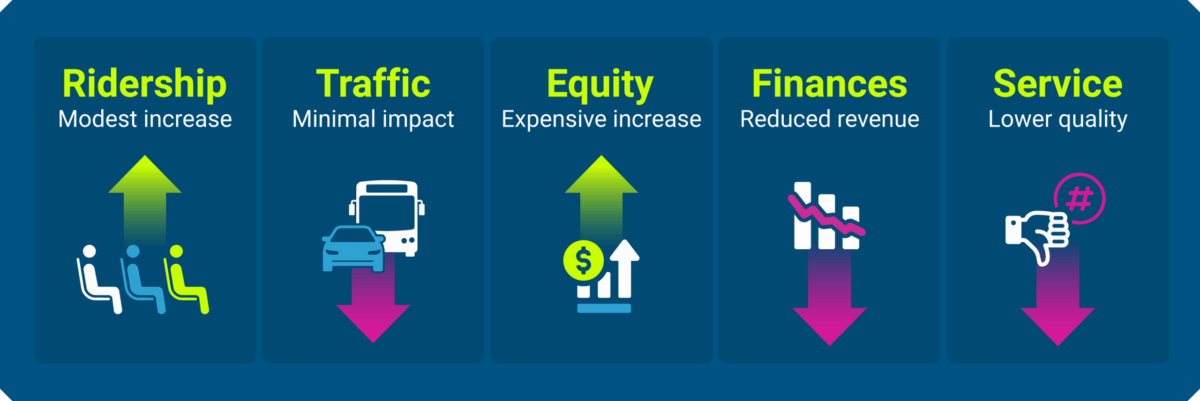
- Increase ridership: YES, but increases in ridership are modest and often temporary
- Reduce car traffic: NO, any impact is minimal
- Improve equity: YES, but going fare-free is an expensive way to do it
- Improve finances: NO, going fare free often worsens financial sustainability
- Improve service quality: NO, going fare free is more likely to strain operations
In general, fare-free transit is only feasible in small systems with low farebox recovery ratios. It rarely works in large metro systems, which are more dependent on farebox revenue. High-performing agencies tend to focus on service quality first and targeted affordability second.
Going fare-free can also have a deleterious effect on federal funding. Farebox recovery isn’t just revenue — it’s leverage for federal matching, and eliminating fares changes your political funding risk profile. Maintaining technology flexibility protects your agency from policy swings.
6 reasons to continue collecting fares
Major loss of revenue creates financial stress
Transit agencies rely on fares to cover a significant percentage of operating costs. Eliminating them removes an important revenue stream and does nothing to reduce the underlying costs of running service. Operator wages and benefits, maintenance, fuel, and other expenses don’t go down by a similar percentage just because revenue does.
To make up the gap, cities must commit to long-term tax funding. This requires them to raise taxes, cut other services, or borrow more, which is politically and economically difficult, especially in larger cities with already tight budgets.
Ridership increases have little impact on congestion and emission reduction
Free transit may increase boardings initially, but much of the gain tends to come from people who previously walked, biked, or made optional trips, not from drivers switching to transit. That means little impact on congestion or emissions. Additionally, any increases may be temporary.
Research from fare-free experiments shows that meaningful reductions in traffic or pollution remain elusive unless ridership increases dramatically. Research suggests that ridership needs to increase 74 to 192 percent to result in measurable ozone improvements.
More riders require more staff and equipment to prevent operational and service quality challenges
Adding more riders without expanding service capacity can overload vehicles, slow boarding and operations, and reduce schedule reliability, making the system less attractive to riders. To maintain quality in the face of increased demand, agencies would need to buy more vehicles or hire additional staff, further raising costs in the face of reduced revenue.
Safety, security, and social issues lead to negative perception
Fares act as a psychological and practical barrier that can limit loitering, disorderly behavior, and misuse of transit vehicles and stations. Removing fares has been shown to lead to increased reports of disruptive passengers and a perception of unsafe environments. Agencies that experimented with fare-free transit reported rises in vandalism, conflicts, or shelter-seeking behavior on vehicles, contributing to operator discomfort and community complaints and driving away choice riders, ultimately resulting in ridership decreases.
Most agencies struggle to absorb the revenue loss
When fare-free works best, it’s in low-ridership systems with already limited service. Free transit is more sustainable in smaller cities, resort towns, college campuses, or rural areas where farebox revenue represents a tiny portion of costs and demand is manageable. Larger urban and suburban systems with high ridership and complex operations struggle to absorb the revenue loss and operational impacts of fare elimination.
Core barriers to ridership remain
Transit’s real challenges are quality and convenience. Many travelers choose cars because transit is slow, infrequent, or inconvenient — not because of the price. Improving frequency, speed, and reliability tends to do more to attract motorists than eliminating fares alone.
While fare-free can help low-income riders by reducing direct cost barriers, broader impacts on access to jobs or services depend on overall network quality and household travel patterns.
5 alternatives to full fare elimination
Targeted fare programs
Means-tested reduced or free fares for qualifying riders are a better option than eliminating fares for everyone. Programs for low-income riders could include income-based passes, SNAP-linked discounts, and/or Medicaid eligibility integration. Youth, senior, off-peak, and summer free or reduced fare programs also support equity.
Qualified reduced and free fares work because they directly support equity goals while preserving fare revenue from riders who can afford to pay.
Fare capping
Fare capping is gaining in popularity. It allows riders to pay per trip using smart cards, mobile apps, or open payment, but once they hit a daily/weekly/monthly cap, additional rides are free. It’s essentially a pay-as-you-go period pass that doesn’t strand unused funds.
Fare capping eliminates the need to buy weekly or monthly passes upfront while supporting frequent riders and maintaining revenue integrity. It’s been adopted in London, New York, Chicago, and other large systems.
High-equity corridors
Instead of systemwide elimination, free fares can be targeted to specific routes. Types of routes that could be targeted include bus rapid transit, downtown circulators, school-focused routes, and airport or commuter rail connectors. These routes could be free all the time or just during certain times, such as around school start and dismissal times. This strategy targets congestion or equity corridors without destabilizing the full system budget.
Institutional pass programs
Organizational partnerships, such as with universities, employers, or social service agencies, shift the cost of fares and administration to partners while maintaining revenue. Participating organizations pay transit agencies directly using a flexible pricing model to cover access for the populations they serve. Advantages of organizational partnerships include a guaranteed revenue stream and significant ridership growth, backed by administrative simplicity.
Prioritizing service improvements over fare cuts
Research consistently shows that frequency and reliability matter more than price for attracting riders. Instead of eliminating fares, agencies that want to attract riders can invest in high-frequency bus lines, dedicated bus lanes, signal priority, real-time tracking, and other service improvements. Better service converts more drivers than free fares alone.
Flexibility is key
Whether you move toward fare-free, targeted discounts, or maintain fares — the flexibility of your fare system matters. Our role at Genfare is to help ensure whatever direction you choose is financially sustainable, operationally sound, and has the infrastructure to support later policy shifts smoothly. The decision your transit agency makes about fares is policy. Your fare collection technology should give you options.
For example, if you go fare-free, you’ll still need data validation, ridership tracking, grant reporting, and measurement tools. If you launch a fare-free pilot, it’s likely you will require temporary or route-level fare configuration. If you continue collecting fares, you’ll want technology that enables fare capping, organizational partnerships, and account-based ticketing.